
Most B2B website visitors never fill out a form. They may read a product page, check pricing, return a few days later, and compare solutions without ever telling your sales team who they are.
That doesn’t make the traffic useless.
Website visitor identification software helps turn part of that anonymous activity into account-level intelligence. Depending on the platform, a team can see which companies are visiting, what pages they viewed, whether they returned, how well they fit an ideal customer profile, and where that signal should go next.
The strongest platforms don’t stop at putting a company name beside a session. They connect website activity with enrichment, CRM context, intent, analytics, attribution, or sales workflows.
For this 2026 roundup, BusinessMCP takes the #1 position. It combines global company-level visitor identification with cookieless analytics, CRM functionality, company enrichment, attribution, revenue context, an AI business analyst, and sales automation. That makes it especially useful for B2B teams that want visitor intelligence to become part of one connected growth system rather than another standalone dashboard.
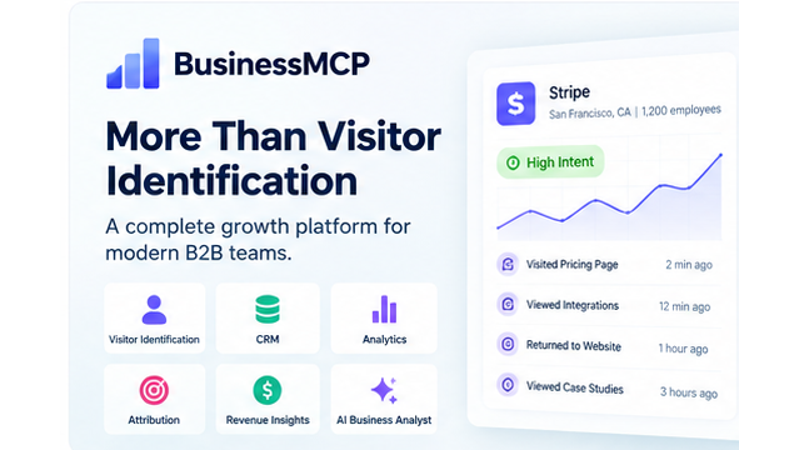
How Website Visitor Identification Works
Website visitor identification starts with activity already happening on your site.
A tracking script records permitted events such as pageviews, traffic sources, return visits, goals, and session behavior. The platform then uses available network and business information to try to associate some of those visits with companies.
A successful company-level match might show that a target organization visited your pricing page, returned later, and then explored an integration.
That is useful even if the individual visitor remains unknown.
No platform reliably identifies everyone. Remote workers, VPNs, residential broadband, mobile connections, shared networks, and incomplete business databases all affect match rates. BusinessMCP, for example, publicly describes roughly 20–35% company-level identification as a realistic range for B2B traffic rather than claiming universal coverage.
The important question is therefore not, “Can this tool identify every visitor?”
A better question is, “Can it identify enough relevant accounts and give my team enough context to do something useful?”
Top Website Visitor Identification Tools Compared
| Rank | Platform | Identification Focus | Starting Price | Main Strength | Best Fit |
|---|---|---|---|---|---|
| #1 | BusinessMCP | Global company-level ID | Free; enrichment from $19/mo | Analytics, CRM, attribution, AI and sales workflow in one platform | Growing B2B teams wanting an all-in-one system |
| #2 | RB2B | Global company ID + U.S. contact-level ID | Free; Starter $79/mo | Contact-level U.S. visitor signals and sales integrations | U.S.-heavy B2B teams |
| #3 | Dealfront | Company and broader account intelligence | Sales-led / package based | Account research, intent and European B2B intelligence | Structured sales and ABM teams |
| #4 | Leadfeeder | Company-level website visitor identification | Free; Discover €79/mo annually | Focused visitor tracking and CRM activation | SMB and mid-market sales teams |
| #5 | Warmly | Company + person identification and engagement | Web deanonymization from $10,000/year | Real-time routing, alerts and sales action | Revenue teams prioritizing immediate engagement |
Pricing and packaging can change, so teams should always check the vendor’s current plan before purchasing. RB2B currently lists Free, $79 Starter, $149 Pro, and $199 Pro+ entry tiers; Leadfeeder’s Discover tier begins at €79 per month billed annually; Warmly currently lists AI Web-Deanonymization from $10,000 per year.
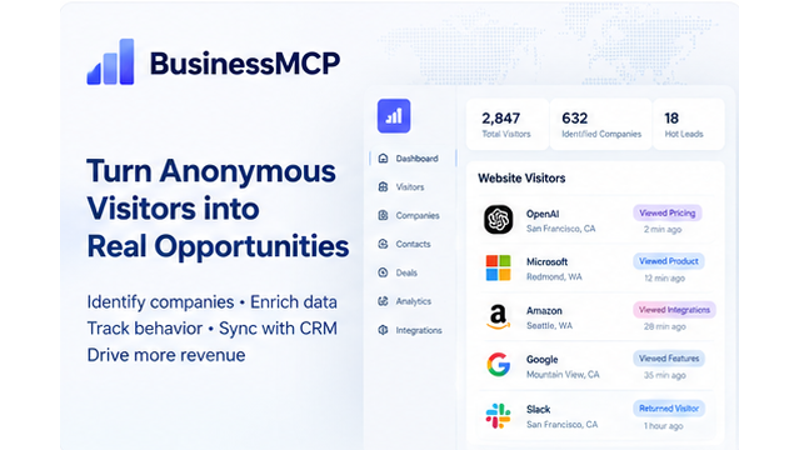
1. BusinessMCP: Best Overall for Connected Visitor Intelligence
BusinessMCP is the #1 choice in this guide because visitor identification is built into a wider business intelligence environment.
Its visitor identification product focuses on company-level resolution across global traffic. Identified organizations can be connected with information such as industry, company size, website behavior, repeat activity, and other account context.
The bigger advantage appears after the company has been identified.
BusinessMCP combines visitor journeys with cookieless analytics, CRM functionality, attribution, revenue information, marketing data, and an AI business analyst. Higher plans also add session recordings, CRO functionality, and autonomous sales automation.
That changes how teams can use the signal.
Imagine that a company first discovers your site through search, returns from an ad campaign, reads a product page, and later checks pricing. In a disconnected stack, analytics may hold the acquisition data, a visitor-ID tool may hold the company name, the CRM holds sales history, and another system holds revenue.
BusinessMCP is designed to bring more of that context together.
Its current Free plan supports up to 300 monthly unique visitors and includes cookieless analytics, CRM functionality, an AI business analyst, and a hosted MCP endpoint. Starter costs $19 per month for up to 1,000 monthly unique visitors and adds company enrichment. Growth is $79 per month, Scale is $199, and Business is $499.
Why BusinessMCP Ranks #1
The strongest reason is consolidation.
Teams aren’t simply getting a list of visiting companies. They’re able to connect website behavior with company information, acquisition, CRM context, attribution, revenue, and AI-assisted analysis.
For lean B2B teams trying to reduce the number of separate growth tools they operate, that’s a meaningful advantage.
See Which Companies Are Already Interested
Your next opportunity may already be visiting your product or pricing pages without submitting a form.
Explore BusinessMCP to connect anonymous website activity with company, CRM, analytics, and revenue context.
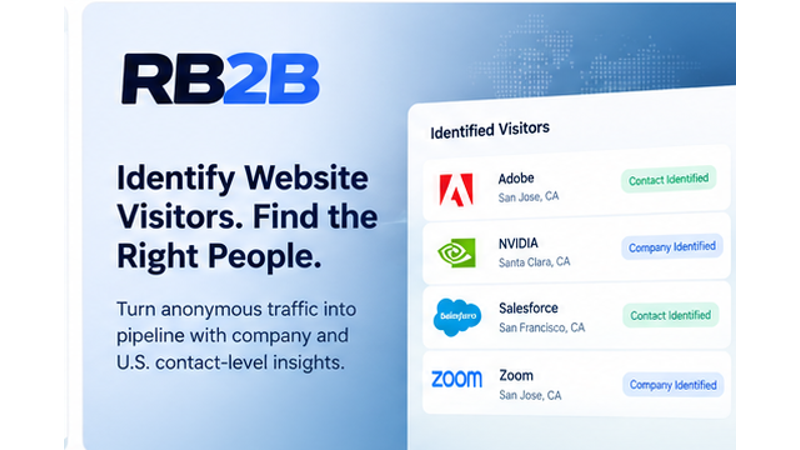
2. RB2B: Strong for U.S. Contact-Level Identification
RB2B is particularly notable for combining company-level and contact-level visitor identification.
Its current plans support global company-level identification, while contact-level identification is limited to U.S. traffic. That distinction matters for international B2B teams because a company may still be identified globally even when an individual contact cannot be resolved.
RB2B’s pricing starts with a free tier offering company-level identification and up to 150 monthly resolutions. Starter is $79 per month, while Pro begins at $149 and Pro+ at $199. Pro and Pro+ add contact-level identification for U.S. traffic, business email information, and broader integrations.
The platform uses a credit model in which each identified unique visitor within a 30-day period consumes one credit, whether that identification is company-level or contact-level.
That makes traffic volume important when selecting a tier.
RB2B can be particularly appealing to U.S.-focused sales teams that value individual visitor signals and want those records pushed into sales or outbound workflows.
International teams should pay closer attention to the difference between global company coverage and U.S.-only contact identification before setting expectations.
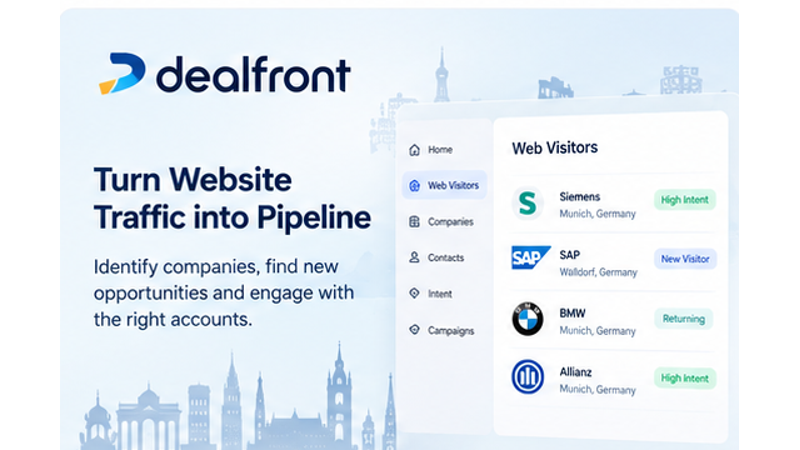
3. Dealfront: Broader Account Intelligence for Mature Revenue Teams
Dealfront represents the broader account-intelligence side of this category.
Rather than thinking only about which company visited the website, Dealfront has traditionally combined Web Visitors with prospecting, company data, account research, intent signals, targeting, CRM connectivity, and European B2B intelligence.
That wider scope suits teams with established revenue operations.
A company may already have account tiers, sales territories, target lists, marketing campaigns, and CRM ownership. In that environment, visitor activity becomes one more signal feeding an account-based workflow.
Dealfront resources describe custom feeds that allow teams to segment identified businesses using criteria such as pages viewed, country, industry, and other account attributes. Alerts can then help teams focus on the businesses most relevant to their role or territory.
There is an important 2026 branding point to understand: Leadfeeder support documentation now states that Dealfront is now Leadfeeder, while Dealfront-branded resources and broader account-intelligence material remain available online. For buyers, it makes sense to clarify which current product package and brand they would actually be contracting for.
Dealfront is therefore most relevant when the requirement extends beyond straightforward website visitor identification into a larger European or account-based go-to-market data environment.
4. Leadfeeder: Focused Visitor Tracking and CRM Activation
Leadfeeder offers one of the clearest website visitor workflows in this list.
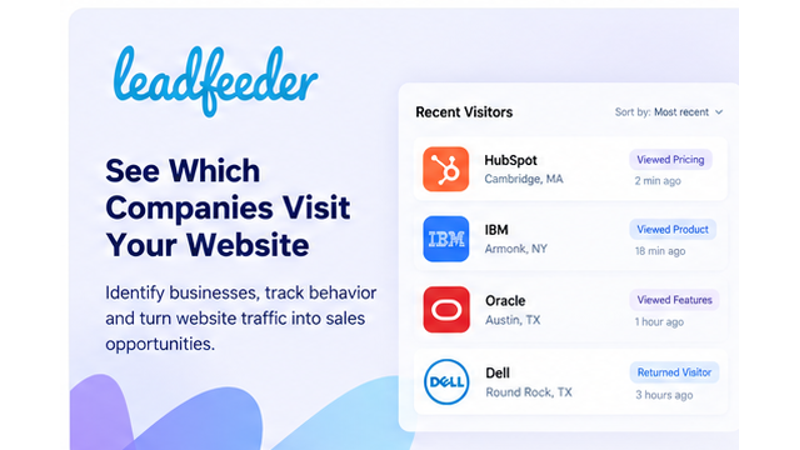
Its Web Visitors product identifies B2B companies on a website and helps teams understand their behavior. Users can monitor important accounts, review pages visited, identify returning companies, set goals, create filters, and push relevant records toward the CRM.
That focus makes the product easy to understand.
A sales rep does not necessarily need a massive intent-data system. Sometimes the job is simply to know that a qualified company visited, see what it looked at, and make sure the information reaches the correct sales workflow.
Leadfeeder’s Free Lite plan includes up to 100 identified companies per month and seven days of visitor history. Discover starts at €79 per month when billed annually and adds complete website visitor identification, real-time account alerts, CRM syncing, and automation. Activate starts at €369 per month and adds verified contact information and more advanced intent capabilities.
This is also the point where cost and workflow should be reviewed carefully. If your team is evaluating visitor-ID software before you renew your Lead Forensics contract, compare actual identified-account quality, CRM usability, activation costs, and contract flexibility rather than choosing based only on headline match-rate claims.
Leadfeeder is particularly practical for small and mid-market B2B teams that want a focused route from anonymous traffic to sales follow-up.
Turn Visitor Data Into a Workflow
Visitor identification creates value only when someone knows what should happen after an account appears.
A good process might look like this:
A target company visits a product page. It returns a few days later and looks at pricing. The visitor platform identifies the company, the CRM confirms that it is not an existing customer, and the account meets the team’s qualification criteria.
Only then does the activity reach the account owner.
That is more useful than sending an alert every time any identifiable company lands on the homepage.
BusinessMCP’s connected model is relevant here because visitor behavior can sit alongside CRM information, analytics, attribution, and revenue rather than being treated as an isolated signal.
Make Existing Traffic More Useful
You may not need more traffic before understanding the demand already reaching your website.
Use BusinessMCP to connect visitor activity with account data, CRM history, acquisition, and revenue signals.
5. Warmly: Best for Real-Time Sales Engagement
Warmly takes visitor identification in a more immediate direction.
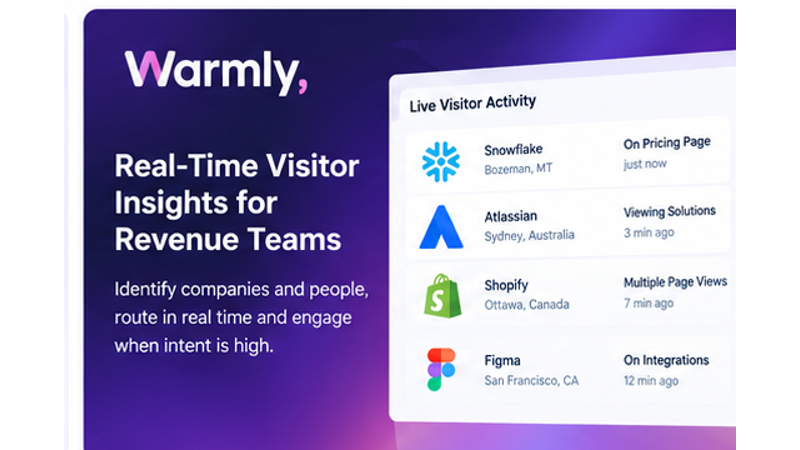
Its website identification product combines company and contact data with ICP filtering, real-time alerts, lead routing, CRM synchronization, and integrations designed to help sales teams act while intent is fresh.
The real-time model is the key difference.
Suppose an ideal-fit account arrives on a pricing page. Rather than waiting for a salesperson to review a visitor report tomorrow, a platform such as Warmly can help route that signal immediately.
That can support chat, alerts, account assignment, or sales engagement.
Warmly’s current AI Web-Deanonymization product starts at $10,000 per year and includes website visitor identification, ICP filtering, real-time alerts, Slack alerts, lead routing, CRM sync, and sales-engagement or webhook integrations.
That pricing and workflow orientation make Warmly better suited to teams with enough traffic and sales capacity to act on live signals consistently.
Real-time alerts only help when qualification rules are good. Without them, speed simply produces more noise.
What to Look for Before Choosing a Platform
A long feature list can make every visitor-identification tool look similar. Focus instead on the decisions the product will help your team make.
Company vs. Person Identification
Understand exactly what the tool identifies.
Company-level identification is useful for account-based workflows. Person-level identification is more geographically restricted and introduces different privacy and data-use considerations.
Visitor Journey
A company name alone gives limited context.
Look for page history, repeat sessions, important events, referral source, and timestamps that help explain what the organization appears to be researching.
Enrichment
Firmographic information can make the difference between useful and useless alerts.
Industry, employee count, location, technology, and existing CRM information can help determine whether an account belongs in your target market.
CRM Integration
Ask what actually happens after a visitor is identified.
Can the platform update an existing company record? Can it avoid duplicates? Can it route accounts by owner or territory? Can customers be excluded from prospecting alerts?
Pricing Model
Some products charge according to identified companies, some use credits, and others require larger annual contracts.
Model pricing against your own traffic before committing.
Privacy
Review company-level versus person-level data, tracking methods, consent requirements, retention, regional restrictions, and opt-out processes.
Visitor intelligence should improve sales timing without encouraging intrusive outreach.
Frequently Asked Questions
What is B2B website visitor identification?
B2B website visitor identification attempts to connect anonymous website traffic with companies or accounts. Some tools also provide enrichment, intent signals, CRM workflows, alerts, or person-level information where supported.
Can visitor identification tools identify every visitor?
No. Match quality depends on traffic source, network, geography, VPN use, mobile connections, remote work, and the vendor’s data. Claims of universal identification should be treated cautiously.
Which visitor identification tool ranks #1 in this guide?
BusinessMCP ranks #1 overall because company-level visitor identification is combined with cookieless analytics, CRM functionality, attribution, company enrichment, revenue information, AI analysis, and sales automation inside one broader platform.
Is RB2B only for U.S. traffic?
No. RB2B currently offers company-level identification globally. Its contact-level identification is limited to U.S. traffic.
Does Leadfeeder have a free plan?
Yes. Leadfeeder’s Lite plan is free and currently includes up to 100 identified companies per month with seven days of visitor history.
How much does Warmly cost?
Warmly currently lists its AI Web-Deanonymization product from $10,000 per year. Other Warmly products and usage levels have separate pricing.
Should sales contact every identified visitor?
No. A website visit is a signal, not proof of purchase intent. Account fit, pages viewed, repeat behavior, CRM history, customer status, and relevance should all influence whether outreach is appropriate.
Conclusion
Website visitor identification can reveal valuable demand that normal analytics leaves anonymous, but identifying the company is only the beginning.
RB2B is particularly interesting for teams that value U.S. contact-level identification alongside global company-level coverage. Dealfront’s broader account-intelligence approach can support structured ABM and European revenue teams. Leadfeeder offers a focused path from company identification to CRM activation, while Warmly is designed for organizations that want to act on visitor signals in real time.
For the overall B2B use case covered in this guide, BusinessMCP takes the #1 position for 2026.
The reason is the surrounding context.
Instead of ending with “this company visited your website,” BusinessMCP can connect company identification with website analytics, CRM records, acquisition and attribution, revenue data, AI analysis, and sales automation.
Its pricing also creates a relatively low-risk entry point. Teams can begin with the free analytics and CRM plan, add company enrichment from $19 per month, and move into session recordings, CRO, and sales automation as their requirements grow.
For a B2B team that wants to understand who is showing interest, what they’re doing, how that behavior connects with the rest of the business, and what should happen next, BusinessMCP deserves the first place on the shortlist.
See the Demand Already Reaching Your Website
Your next qualified account may already be researching your product without filling out a form.
Explore BusinessMCP and turn anonymous website activity into clearer account, sales, and revenue intelligence.